L1 CNS (Larva1099) eFIB-SEM CATMAID Data Viewer
This CATMAID (Collaborative Annotation Toolkit for Massive Amounts of Image Data) instance hosts the enhanced focused-ion-beam SEM (eFIB-SEM) volume of a Drosophila first instar larva central nervous system (sample 1099), together with a curated set of identified, named neuron reconstructions.
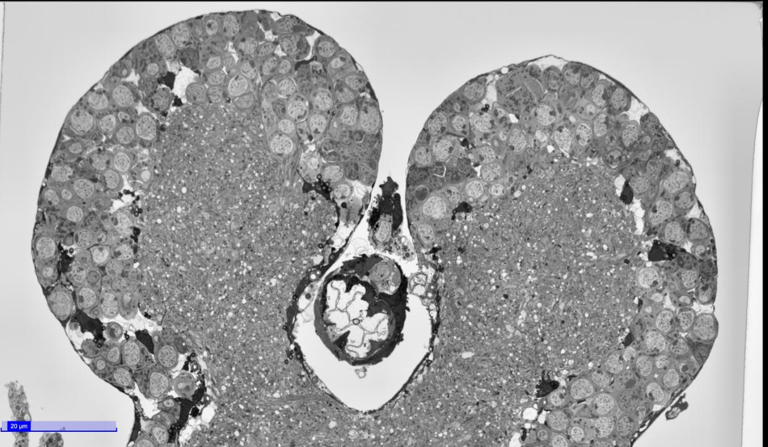
Access
The Larva1099 CATMAID instance is hosted and maintained by Virtual Fly Brain (VFB) as part of its mission to integrate and preserve key Drosophila neuroscience datasets. The instance is accessible at: https://larva1099.catmaid.virtualflybrain.org/
This is a distinct volume from the L1EM serial-section TEM dataset also hosted by VFB: it is a separate first instar larva (sample 1099) imaged by enhanced focused-ion-beam scanning electron microscopy (eFIB-SEM) at 12 × 12 × 12 nm/voxel isotropic resolution.
Source Publication
The volume and reconstructions are from:
- Randel N, Wang C, Clayton MS, Wang K, Pang S, Xu CS, Champion A, Hess HF, Cardona A, Keller PJ, Zlatic M (2026) Combining brain-wide activity imaging with electron microscopy reveals a distributed nociceptive network in the brain. bioRxiv 2025.09.25.678485. https://doi.org/10.1101/2025.09.25.678485 (preprint, in revision)
Dataset Contents
The viewer provides access to:
- The complete eFIB-SEM image volume of a Drosophila first instar larva CNS (sample 1099), 12 × 12 × 12 nm/voxel, served as N5
- A curated set of identified, named neuron reconstructions exported from the source project for hosting on VFB
- The associated neuron and annotation metadata
The hosted set is the curated, named-neuron export rather than the complete connectome; each skeleton carries its neuron-name annotations.
Features
This CATMAID instance enables:
- Browser-based visualisation of the eFIB-SEM image volume
- Navigation through the image stack
- Viewing of neuron reconstructions
- Neuron-name search
- API access for programmatic data retrieval (documentation: https://catmaid.readthedocs.io/en/stable/api.html): https://larva1099.catmaid.virtualflybrain.org/apis/
Recommended: VFB pass-through API
For most uses, the fastest and simplest way to pull data out of this instance is VFB’s
CATMAID pass-through, v3-cached.virtualflybrain.org — it takes VFB ids as well as native
skeleton ids (skids), needs no token or CSRF cookie, and is documented interactively at
v3-cached.virtualflybrain.org:
curl "https://v3-cached.virtualflybrain.org/catmaid/larva1099/annotations_for_skeletons?ids=16"
See the CATMAID API page for the full command list, VFB-id/skid resolution, and response format. The direct, native CATMAID API below remains available for anything the pass-through’s command list doesn’t cover.
Public API token
Read-only access to this instance is open to everyone, but most of CATMAID’s query
endpoints are POST rather than GET, and POST requests are subject to a CSRF check.
Command-line and server-side clients (pymaid, curl, scripts) can satisfy that check by
requesting a page first and replaying the cookie they are given. Code running in a
browser cannot: it can neither read a cookie belonging to another site nor set a
Referer header. Browser-based tools should therefore authenticate as the anonymous
user, using this token:
b0cbcf16d84f2b820673471445e3d64d04797d06
This token is published deliberately and is not a secret. It authenticates as
AnonymousUser, whose only permission on this project is can_browse, so it grants
exactly the read access this page already offers to everyone and nothing further.
Write requests made with it are refused by the server.
Send it in either the X-Authorization or the Authorization header:
curl -X POST https://larva1099.catmaid.virtualflybrain.org/1/skeleton/neuronnames \
  -H "X-Authorization: Token b0cbcf16d84f2b820673471445e3d64d04797d06" \
  --data "skids[0]=16"
Citation Guidelines
When using this data, please cite:
The source dataset: Randel N, et al. (2026) Combining brain-wide activity imaging with electron microscopy reveals a distributed nociceptive network in the brain. bioRxiv 2025.09.25.678485. https://doi.org/10.1101/2025.09.25.678485
The CATMAID platform: Saalfeld S, Cardona A, Hartenstein V, Tomančák P (2009) CATMAID: collaborative annotation toolkit for massive amounts of image data. Bioinformatics 25(15): 1984-1986. https://doi.org/10.1093/bioinformatics/btp266
Maintenance & Support
This resource is archived, hosted, and maintained by Virtual Fly Brain (VFB - https://virtualflybrain.org) as part of its commitment to preserving and making accessible critical Drosophila neuroscience data resources.